

Why Design Thinking Is Essential for Agile Success (Part 1)


Is there a solution for Quality crisis in Agile?

Agile development is the go-to methodology for rapid software delivery, these days. However, the non-stop chase of faster time-to-market is compromising product quality. At the recent Agile+DevOps Techwell Event in Orlando, Florida, Muffins founding team emphasized the urgent need to bring back Design Thinking into Agile and Scrum development. By combining Agile's iterative structure with the human-centric approach of design thinking, organizations can achieve both speed and quality, and outperform their competitors in the process. In this blog post, we will cover the key insights shared by Ravi Krishna & Sai Sasidhar and explore how organizations can implement design thinking to enhance their agile projects.

The Reality : Design Thinking is getting shorter
"Design thinking is shorter and inadequate in Agile, today!"
While teams recognize the value of combining design thinking with agile workflows, only a small percentage successfully integrate design thinking processes seamlessly into their agile practices.
We at Muffins have observed that the rapid pace of agile sprints is forcing design shortcuts. Teams prioritize feature delivery over user experience. This lack of user-centered design leads to products that are technically sound but fall short in usability and user satisfaction. Many teams are struggling to balance the demands of Agile sprints with the time-consuming nature of design thinking. This often results in rushed design decisions and products with quality issues or missed deadlines.
Lets discuss the whys (reasons) behind this quality crisis.
Reason 1: Lost Knowledge between the ‘Requirements phase’ and the ‘Scrum phase’
Today, Design Thinking is narrowly focused on the requirements phase –
- creating user stories
- capturing the designer's perspective with product managers and business owners
However, once these requirements are handed over to Scrum teams – Project leads, Scrum Masters, Developers, and testers, significant knowledge is lost in translation. The focus shifts to technical implementation, and this rapid transition creates a gap between business owner expectations and the final product.
This is important because - business owners and end users frequently find mismatches between their vision and the delivered product. This leads to rework, frustration, and delayed releases.
Reason 2: Design thinking is not extended to the Scrum framework
The whole idea is to integrate design thinking principles into the entire software development - from initial system design to coding, testing, and beyond. This means extending design thinking to Developers when they design systems and write code, and to Testing teams when they write test case designs and execute them.
The constant pressure to meet tight sprint deadlines (1, 2, or 3 weeks) often pushes Scrum teams to take shortcuts. Developers jump directly into coding without adequate upfront design. Many team members rush through implementation. Testers working under time constraints, struggle to balance feature testing with regression testing. As a result, design often takes a backseat.
Reason 3: Testing debt multiplies
When testing is not prioritized within the same sprint, a big backlog of tests gathers. Due to this, many defects are discovered late in the release cycle. This multiplying effect forces teams to either compromise on testing scope or extend timelines. We have observed this issue across our clients and prospects.
Reason 4: Testing in the same sprint is a big challenge
To maintain high quality along with fast delivery, test coverage covering all requirements needs to be increased. However, teams face multiple blocks :
- Limited time within sprints
- Smaller teams with low Developer-Tester ratios (often 3:1, 5:1, or even 10:1)
- Dynamic nature of Agile development with many moving parts
- Frequent requirement changes
Therefore, balancing rapid delivery with quality assurance turns out to be a constant struggle. To address these challenges, Automation and Continuous testing have become essential. Automating features developed in the current sprint ensures thorough testing. And it also enables their seamless integration into regression testing for future sprints.
Reason 5: Miss Design = Miss Testing of Edge cases
Due to lack of time, testers often resort to ad-hoc testing, relying on experience and intuition. This approach can be efficient in the short term, but it leads to :
- missed edge cases
- inadequate test coverage
- regression testing challenges in subsequent sprints
A structured test design process – that involves an analysis of every requirement and designing comprehensive test cases, leads to an efficient regression. However, maintaining this approach within rapid sprint cycles still is a big challenge.
The Solution : Balancing Quality and Speed
Two key recommendations:
- Generative Design + Automation
- No-Code Automation with AI capabilities + LLMs and SLMs
In Part 2, we will dive deep into our two recommendations as well as Muffins, No-Code AI powered Test Automation platform. Should you want to know more about Muffins or schedule a Demo, do connect with us.
What makes Muffins different
It is a fully automated testing solution that requires no coding expertise and leverages the power of AI to optimize both test designing and the testing process - bringing Design Thinking back into the testing phase of Agile development.
Frequently asked questions
Quality crisis comes from agile teams prioritizing feature delivery speed over the rigor of design and testing. Due to tight sprint deadlines (often 1-3 weeks), teams may take shortcuts in design and coding. This often results in a technically sound product – with quality issues or missed edge cases, impacting the usability.
Design Thinking validates assumptions early and aligns teams around real user needs. This prevents rework, misaligned features, and late-stage quality issues. And this eventually saves time and ensures the product meets actual user needs.
Design thinking should extend beyond the initial concept phase to include the testing process. For testers, this means moving away from ad-hoc testing based on intuition and adopting a structured "test design" approach. By analysing requirements deeply to design comprehensive test cases, including complex and edge cases, testers can ensure higher quality coverage within the sprint.
Testing within the same sprint is difficult due to limited time, frequent requirement changes, and low developer-to-tester ratios. These limitations often force teams to compromise on testing scope or neglect regression testing, leading to a backlog of defects that piles up before the release.
Muffins bridges the gap through Generative Design combined with Automation and No-Code AI-powered tools.
By incorporating LLMs and SLMs to automate complex test designs and execution, teams maintain high-quality standards without slowing down release speeds.
Subscribe today.
Thank you!
Quality crisis in Agile
Design Thinking is shorter
The Solution : Balancing Quality and Speed
More related blogs

Transition to Test Automation made easy for Manual Testers - Muffins
- March 12, 2025

The Big Trends shaping Software Testing and Quality Assurance in 2025
- January 21, 2025
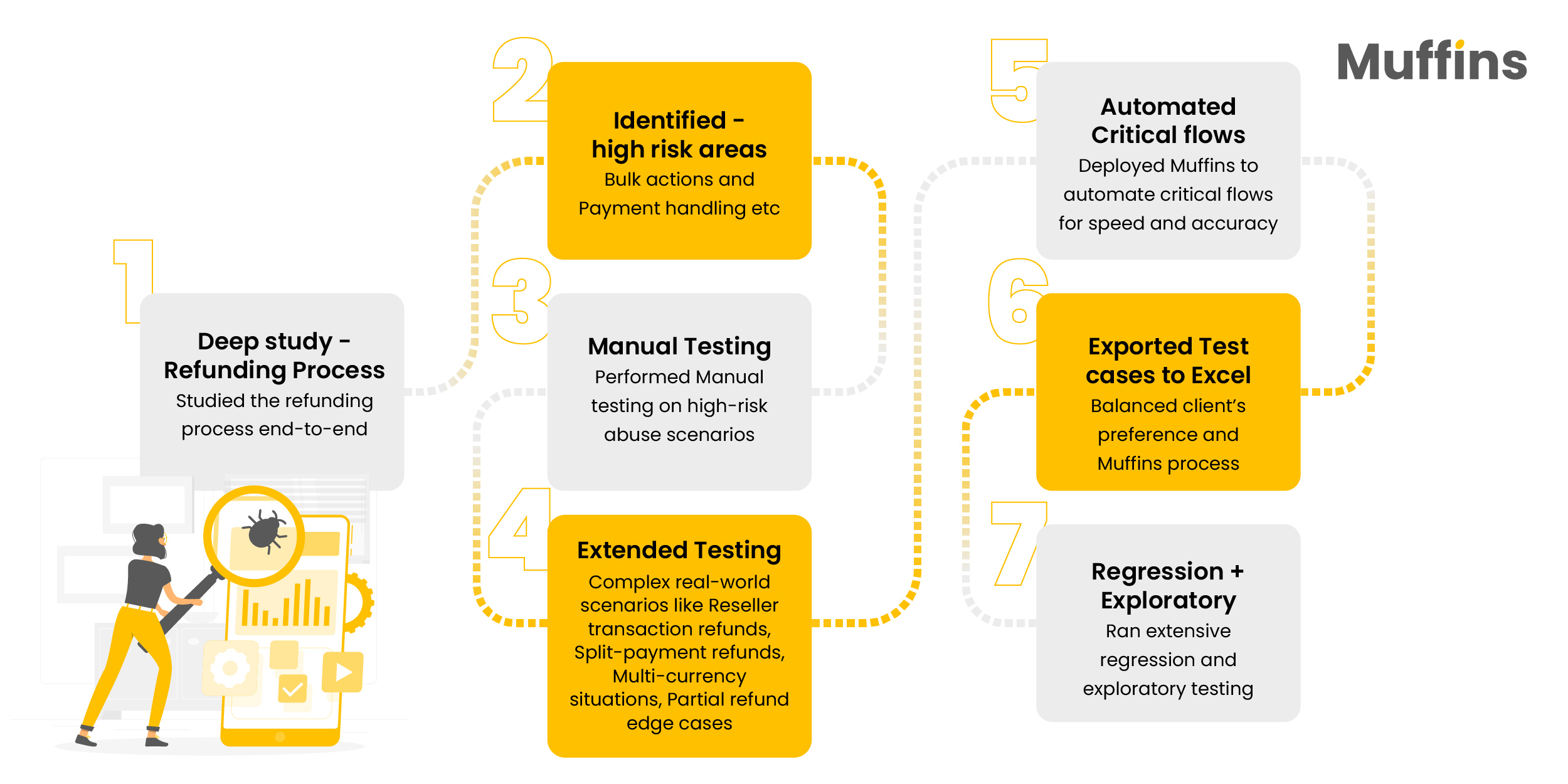
Structured & Traceable QA for a Mexico-based top Entertainment ticketing company
- May 14, 2025